
Introduction
In today's digital-first business environment, an application is more than just a software product. It is a powerful tool for improving customer experiences, automating operations, increasing productivity, and creating new opportunities for business growth.
Whether you're building an e-commerce platform, a customer portal, an internal business application, or a SaaS product, the right features can determine how effectively your application serves its users.
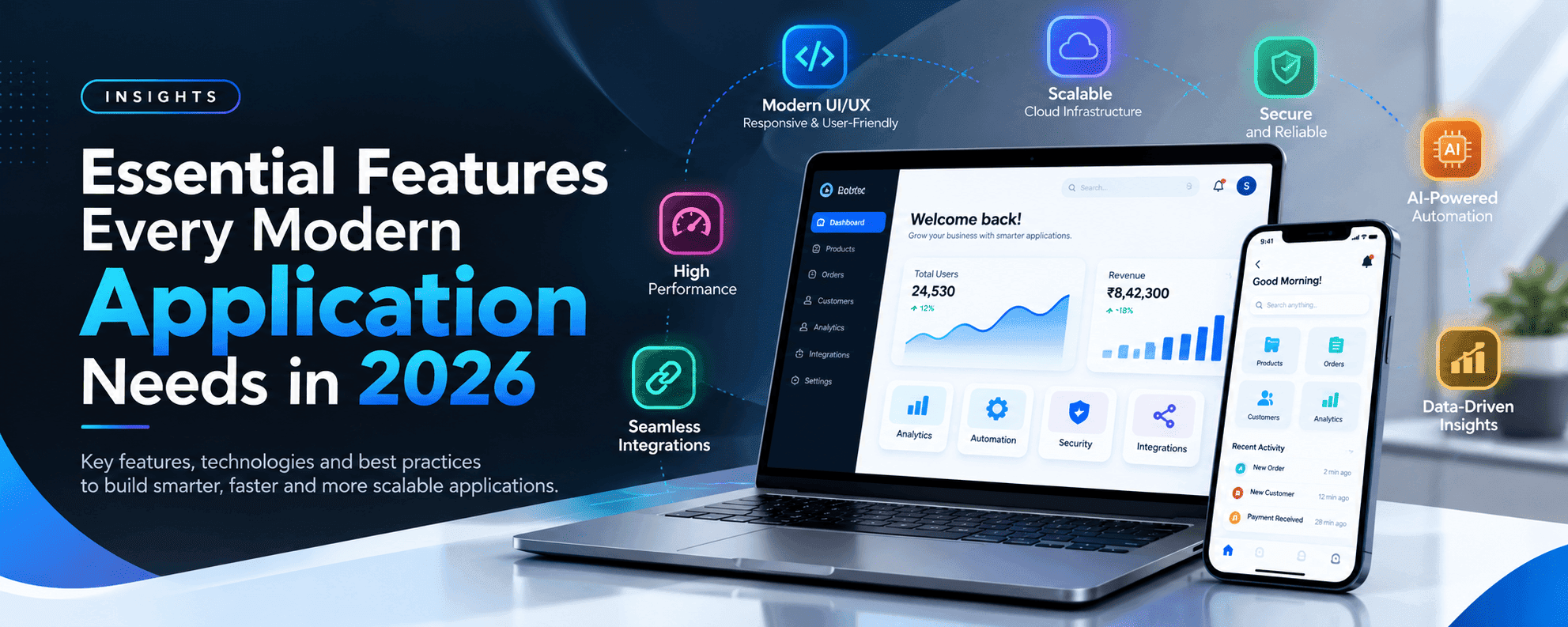
As businesses adopt AI-powered tools, cloud technologies, and digital workflows, application development in 2026 requires a stronger focus on usability, performance, security, and scalability.
At 99 Visual Solutions, we believe modern applications should combine intelligent functionality with practical business value. Here are the essential features businesses should consider when developing a new application or upgrading an existing one.
1. Responsive and User-Friendly Interface
A great application starts with a great user experience. Users expect applications to be intuitive, visually consistent, and easy to navigate across different devices.

A modern application should include:
Responsive layouts for desktops, tablets, and smartphones.
Clear navigation and intuitive workflows.
Accessible design with readable typography and sufficient contrast.
Consistent branding, buttons, forms, and interactive elements.
Simple onboarding that helps users understand key features quickly.
Business benefit: A user-friendly interface reduces friction, improves engagement, and helps customers complete important actions with confidence.
2. High Performance and Fast Loading Speeds
Application speed directly affects usability. Slow pages, delayed interactions, and unresponsive screens can frustrate users and increase abandonment.
Performance should be considered from the beginning of the development process, rather than treated as a final optimization task.
Important performance features include:
Optimized images, scripts, and other assets.
Efficient database queries and API responses.
Caching and appropriate content delivery networks.
Lazy loading for non-critical content.
Performance monitoring and error tracking.
For web applications, modern frameworks such as Next.js can support server rendering, optimized asset delivery, and other performance strategies when implemented appropriately.
Business benefit: Faster applications deliver smoother experiences and can support better conversion rates and search visibility.
3. Strong Security and Data Protection
Security is essential for every application that handles customer information, transactions, employee records, or business data.
A modern application should incorporate security throughout its development lifecycle.
Key security features include:
Secure authentication and role-based access control.
Multi-factor authentication where appropriate.
Encrypted communication using HTTPS.
Secure password storage and session management.
Input validation and protection against common web vulnerabilities.
Regular dependency updates, backups, and security testing.
Businesses should also evaluate applicable privacy and data protection requirements before launching their applications.
Business benefit: Strong security reduces risk, protects sensitive information, and helps build customer trust.
4. AI-Powered Features and Intelligent Automation

Examples include:
AI-powered customer support assistants.
Intelligent search and product recommendations.
Automated document processing and data extraction.
Personalized content and user experiences.
Predictive analytics and business reporting.
Workflow automation for repetitive tasks.
AI features should include appropriate safeguards, privacy controls, and human review where mistakes could have significant consequences.
Business benefit: Well-designed AI capabilities can reduce repetitive work, improve service delivery, and help teams make better-informed decisions.
5. Scalable Architecture and Reliable Infrastructure
An application that works for 100 users today may need to support thousands of users in the future. A scalable architecture makes it easier to accommodate business growth without requiring a complete rebuild.
When planning application development, consider:
A modular and maintainable codebase.
Efficient database design and indexing.
Cloud infrastructure appropriate to the workload.
Background processing for resource-intensive tasks.
Load testing and capacity planning.
Automated deployment and monitoring.
Not every business needs a complex microservices architecture. The right solution depends on the application's size, expected traffic, operational requirements, and budget.
Business benefit: Scalable applications can adapt to growing demand while keeping maintenance and infrastructure decisions manageable.
6. Seamless API and Third-Party Integrations
Businesses rarely operate with a single software system. Modern applications often need to connect with payment gateways, CRM platforms, inventory tools, shipping providers, accounting software, and communication services.
Useful integrations may include:
Payment gateways for secure transactions.
CRM systems for managing customer relationships.
Inventory and order management platforms.
Email, SMS, and messaging services.
Analytics and reporting tools.
ERP and other enterprise systems.
Integrations should use documented APIs, appropriate authentication, error handling, and reliable data synchronization.
Business benefit: Connected systems reduce manual data entry, minimize operational gaps, and create more efficient business workflows.
7. Search Engine Optimization and Discoverability
For customer-facing web applications and e-commerce platforms, discoverability can be just as important as functionality.
SEO should be considered during development, especially when the application includes public pages intended to attract organic traffic.
Essential considerations include:
Search-friendly URLs and page structures.
Unique page titles and meta descriptions.
Semantic HTML and accessible content.
Appropriate structured data where eligible.
XML sitemaps and crawlable internal links.
Canonical URLs and correct redirect handling.
Optimized mobile performance and Core Web Vitals.
Private dashboards and authenticated application screens have different search requirements from public landing pages, product pages, and editorial content.
Business benefit: A search-friendly architecture helps search engines discover relevant public content and supports long-term organic acquisition.
8. Analytics, Reporting, and Business Insights
Modern applications should help businesses understand what users do, where processes slow down, and which features deliver value.
Depending on the application, useful analytics capabilities include:
User engagement and conversion tracking.
Sales, revenue, and order reports.
Operational performance dashboards.
Feature adoption metrics.
Error and reliability monitoring.
Custom reports for different user roles.
Analytics implementation should respect user privacy, applicable consent requirements, and data minimization principles.
Business benefit: Reliable data helps businesses identify opportunities, improve processes, and prioritize future development.
9. Reliable Testing and Quality Assurance
An application can look impressive but still fail if its core workflows are unreliable. Quality assurance helps identify defects before they affect customers or business operations.
A comprehensive testing strategy may include:
Functional testing for essential workflows.
Cross-browser and responsive testing.
API and integration testing.
Performance and load testing.
Security testing.
Automated regression testing for frequently used features.
Automation can make repeated checks more efficient, while manual testing remains valuable for usability and exploratory scenarios.
Business benefit: Better testing reduces production issues, improves reliability, and supports a more predictable release process.
10. Easy Maintenance and Continuous Improvement
Application development does not end when the product launches. Business requirements change, user expectations evolve, and software dependencies require ongoing attention.
A maintainable application should support:
Clear documentation and modular code.
Version control and controlled releases.
Continuous integration and deployment where appropriate.
Error logging and application monitoring.
Routine security and dependency updates.
A structured process for collecting user feedback.
Business benefit: Continuous improvement helps keep the application secure, relevant, and aligned with changing business needs.
Which Features Should Your Business Prioritize?
Every application has different requirements. The best development strategy starts with business goals, user needs, and available resources.
Application type | Highest-priority features |
|---|---|
E-commerce application | Product discovery, secure checkout, inventory, order tracking, SEO |
Business management application | Role-based access, reporting, workflow automation, integrations |
SaaS platform | Authentication, multi-tenancy where needed, billing, scalability, monitoring |
Customer portal | Secure access, personalized dashboards, self-service tools, notifications |
Enterprise application | Identity management, audit trails, system integrations, reliability |
AI-powered application | Relevant AI capabilities, data protection, evaluation, human oversight |
How to Choose the Right Application Development Partner
Choosing a development partner is an important business decision. Beyond technical skills, look for a team that understands your business objectives and can translate them into a practical solution.
Evaluate potential partners based on their:
Experience with similar applications and industries.
Ability to define scope, milestones, and technical requirements.
Approach to UI/UX, security, testing, and performance.
Experience with API integrations and scalable architecture.
Post-launch maintenance and technical support.
Communication, documentation, and delivery processes.
A reliable partner should also explain the trade-offs between different technologies, development costs, timelines, and long-term maintenance requirements.
Conclusion
Modern application development in 2026 is about more than writing code or launching a visually appealing interface. It requires a balanced approach to user experience, performance, security, intelligent automation, scalability, and ongoing maintenance.
Businesses that prioritize these fundamentals can build applications that solve real problems, support operational efficiency, and adapt as their needs evolve.
At 99 Visual Solutions, we help businesses explore web and application development solutions aligned with their goals, from customer-facing digital platforms to business-focused software and integrated digital experiences.
Ready to build or upgrade your application? Let's discuss your requirements and identify the right development approach for your business.
✉ Contact Us Now