
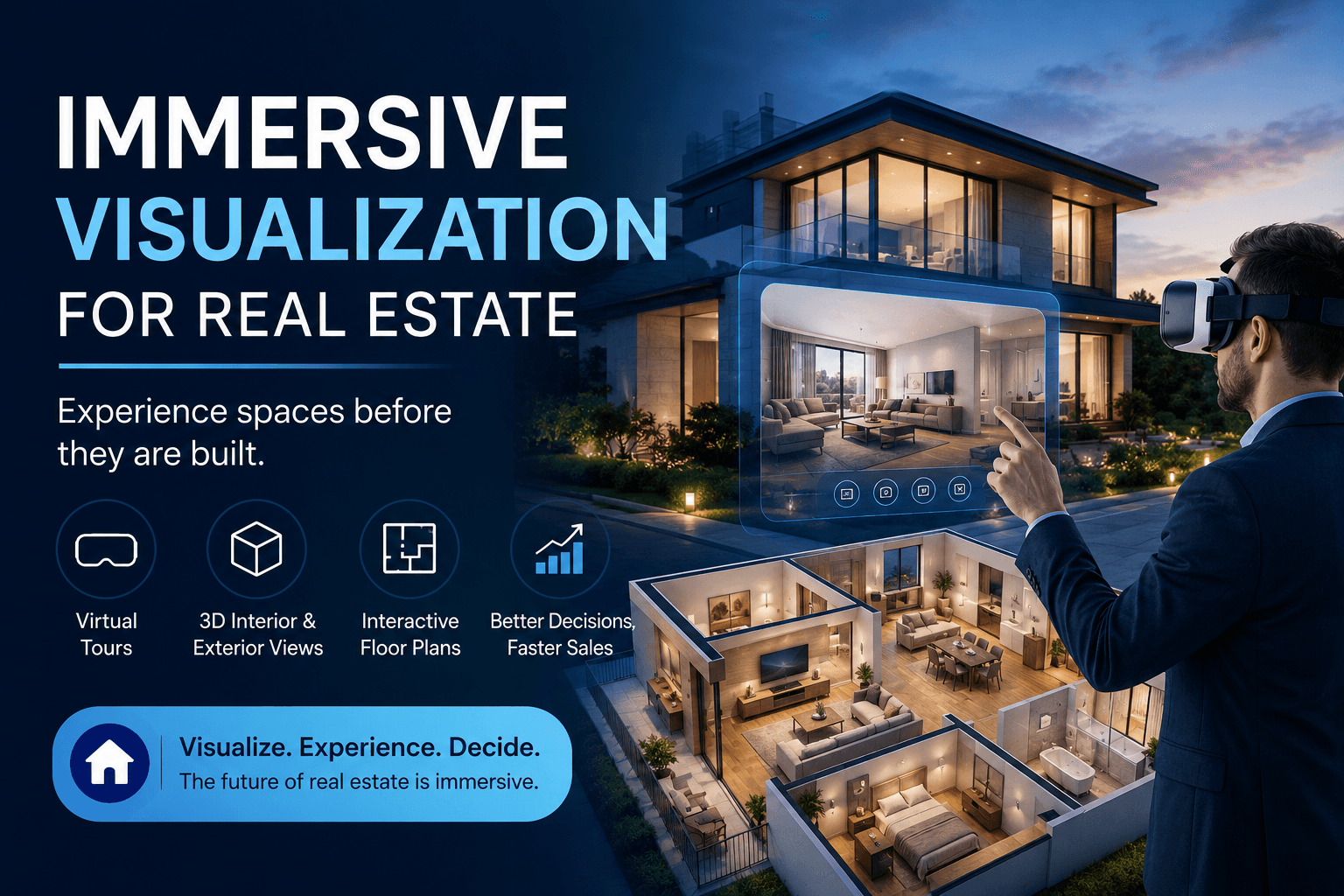
The Way We Present Buildings Has Changed
Selling an unbuilt property once meant handing a client a floor plan and asking them to imagine. That era is over.
Today, buyers can walk through a virtual penthouse before a single brick is laid. Architects can show clients structural changes in real time. Developers can present an entire township — lighting, landscape, ambience — months before ground is broken.
The firms embracing immersive visualization are closing deals faster, cutting costly revisions, and building stronger client trust. Here's what you need to know.
What Is Immersive Visualization?
It's the use of photorealistic 3D rendering, VR, AR, and real-time interactive environments to let clients experience a space before it exists — not just see it.
The core formats:
3D Renders — Photorealistic stills for marketing and approvals
Walkthroughs & Flythroughs — Cinematic animated tours of unbuilt spaces
360° Virtual Tours — Browser or headset-based interactive navigation
VR Experiences — Fully immersive exploration via headset
AR Overlays — Place a 3D building model into the real world via phone or tablet
Real-Time Configurators — Clients change finishes, layouts, and lighting live
Digital Twins — Data-connected 3D models that mirror real-world building performance
Why It's Now a Business Necessity
Reduces costly revisions. When clients walk through a VR model and say "this corridor feels narrow" before construction begins, that feedback costs almost nothing. The same feedback after pouring concrete doesn't. Immersive tools cut change orders by 30–40% on average.
Converts buyers faster. A buyer who has already "walked" every room arrives at signing with confidence, not hesitation. Interactive content consistently outperforms static imagery at every stage of the sales funnel.
Builds emotional connection. People don't buy square footage — they buy how a space makes them feel. When a client sees morning light moving across the living room floor, they stop evaluating and start wanting.
Powers pre-sales at scale. Developers regularly launch and sell units months before completion — not because buyers are guessing, but because compelling visualization gives them the confidence to commit early.
Key Applications
Sector | How It's Used |
|---|---|
Residential | Pre-sales renders, VR showrooms, unit configurators, lifestyle marketing |
Commercial | Investor flythroughs, virtual site tours, workplace fit-out visualization |
Architecture | Client approval at concept stage, material studies, competition submissions |
Infrastructure | Master plan visualization, digital twins, community engagement tools |
How 99 Visual Solutions Can Help
We sit at the intersection of architectural understanding, technical precision, and visual storytelling — delivering:
Photorealistic exterior, interior, and aerial renders
Cinematic walkthroughs and flythrough animations
360° virtual tours (browser-based and VR-ready)
Real-time interactive experiences built on Unreal Engine
3D master plans integrating landscape, infrastructure, and built form
Investor decks, sales suite packages, and planning submission visuals
Every project starts with one question: what does this visualization need to achieve? That drives everything we do.
Ready to Visualize Your Project?
👉 Contact Us— Let's build something worth experiencing.